Author name: Rajattdubeyyy@

Google Ads & PPC, Google Display Ads

How to Create Google Display Ads That Actually Convert in 2026

How to Create Google Display Ads That Actually Convert in 2026 | GROWME GROWME Marketing Insights Paid Media Guide · 2026 How to Create Google Display Ads That Actually Convert in 2026 By GROWME · Published August 7, 2026 · 8 min read A well-designed display ad can turn passive browsing into real conversions. Google Display Ads reach over 90% of internet users worldwide, showing up as banners, images, and videos across millions of websites, apps, and Gmail inboxes. But reach alone doesn’t equal results — most display campaigns fail not because of low visibility, but because of weak targeting, forgettable creative, or unclear calls to action. If you’ve run display ads that got impressions but no real conversions, the problem usually isn’t the platform — it’s the strategy behind it. This guide breaks down exactly how to build Google Display Ads that convert in 2026, from targeting and creative to bidding and measurement. Why Display Ads Still Matter in 2026 Unlike Search Ads, which target people actively looking for something, Display Ads work on passive intent — reaching people while they browse, read, or watch content elsewhere. This makes them powerful for building brand awareness and re-engaging past visitors, but it also means they need a different strategy than search campaigns. In 2026, with AI-driven audience targeting and dynamic creative optimization built into Google Ads, display campaigns are more precise than ever — but only if you set them up correctly. 1. Define a Clear Campaign Goal Before You Design Anything Every high-converting display campaign starts with one specific goal, not a vague hope for “more traffic.” Awareness campaigns: optimize for reach and viewability, not clicks Remarketing campaigns: optimize for conversions from users who already visited your site Lead generation campaigns: optimize for form fills or sign-ups with a clear single offer Trying to achieve all three with one ad set is the fastest way to waste budget. 2. Use Layered Audience Targeting Google’s display targeting works best when you combine multiple signals rather than relying on just one. Remarketing lists: target people who already visited your site or app Custom intent audiences: based on keywords and URLs your ideal customer searches or browses In-market audiences: people actively researching products/services like yours Affinity audiences: broader interest-based targeting for top-of-funnel awareness Layering remarketing with in-market audiences typically outperforms single-signal targeting. 3. Design Creative That Stops the Scroll Follow Google’s Standard Ad Sizes Using the most widely served sizes ensures your ad is eligible for more placements across the Display Network. Ad Size Common Name Best Use 300×250 Medium Rectangle In-content placements, highest availability 336×280 Large Rectangle High-performing in-article placements 728×90 Leaderboard Top-of-page banners on desktop 300×600 Half Page High-visibility sidebar placements 320×50 Mobile Banner Mobile app and web placements Keep Messaging Simple One clear headline, one clear offer, one clear call to action Use your brand color prominently so the ad is instantly recognizable Avoid dense text — display ads are viewed for seconds, not read like a page Use Responsive Display Ads Upload multiple headlines, descriptions, images, and logos Let Google’s AI automatically test and serve the best-performing combinations Include both square and landscape images for maximum placement eligibility 4. Prioritize Remarketing for Higher Conversions Remarketing consistently delivers stronger conversion rates than cold targeting because you’re reaching people already familiar with your brand. Segment remarketing lists by behavior (e.g., viewed product vs. abandoned cart) Show different creative and offers based on how far they got in your funnel Set frequency caps so the same user isn’t shown your ad excessively 5. Choose the Right Bidding Strategy Maximize Conversions: best when you have enough conversion data for Google’s automated bidding to optimize Target CPA: best once you know your acceptable cost per acquisition Manual CPC: useful for new campaigns while you’re still gathering performance data 6. Measure What Actually Matters Click-through rate alone doesn’t tell you if a campaign is working — display CTRs are naturally low (often under 1%) since users aren’t actively searching. Track view-through conversions, not just click-through conversions Monitor cost per acquisition (CPA) against your actual margins Use Google Analytics assisted conversions to see display’s role earlier in the funnel Common Display Ad Mistakes to Avoid Judging performance on CTR alone instead of conversions and assisted conversions Using only one ad size, drastically limiting placement eligibility Sending traffic to a generic homepage instead of a relevant landing page Ignoring frequency capping, leading to ad fatigue and wasted spend Skipping remarketing and only targeting cold audiences Final Thoughts Google Display Ads that convert in 2026 aren’t about flashy design alone — they’re about matching the right audience, the right creative, and the right bidding strategy to a clear campaign goal. Start with remarketing, keep your creative simple and on-brand, and measure success beyond just clicks. Do that consistently, and display advertising becomes one of the most cost-effective channels in your marketing mix. Frequently Asked Questions What is a good CTR for Google Display Ads? Display ads typically see click-through rates between 0.35% and 0.9%, much lower than search ads, since display targets passive browsing rather than active search intent. What image sizes work best for Google Display Ads? The most widely served sizes are 300×250 (Medium Rectangle), 336×280 (Large Rectangle), 728×90 (Leaderboard), 300×600 (Half Page), and 320×50 (Mobile Banner). Is remarketing more effective than cold display targeting? Yes, remarketing campaigns generally deliver higher conversion rates and lower cost per acquisition than cold audience targeting, since they reach users already familiar with your brand. GROWME © 2026 GROWME. All rights reserved.

DIgital Marketing, Marketing Strategy

Top Marketing Strategies Every Business Owner Should Know in 2026

Top Marketing Strategies Every Business Owner Should Know in 2026 | GROWME GROWME Marketing Insights Marketing Strategy Guide · 2026 Top Marketing Strategies Every Business Owner Should Know in 2026 By GROWME · Published August 7, 2026 · 9 min read A clear marketing strategy is the foundation of sustainable business growth in 2026. Marketing in 2026 looks nothing like it did even three years ago. Search engines are answering questions directly through AI Overviews, social platforms are prioritizing short-form video over static posts, and consumers are more skeptical of traditional advertising than ever before. For business owners, this means the old playbook — post a few ads, publish a blog occasionally, hope for the best — no longer cuts it. Success today requires a deliberate, full-funnel marketing strategy that adapts to how people actually discover, evaluate, and buy. In this guide, we’ll break down the marketing strategies every business owner needs to understand and apply in 2026. Why Marketing Strategy Matters More Than Ever in 2026 The biggest shift driving change in marketing is the rise of AI-powered search. With AI Overviews now answering many queries directly on the results page, fewer users are clicking through to websites for simple informational searches. This “zero-click” trend means business owners can no longer rely purely on ranking #1 for traffic — they need visibility across multiple touchpoints, including video platforms, social search, and community-driven spaces. At the same time, consumer trust has moved away from polished corporate messaging and toward authenticity. User-generated content, real customer testimonials, and behind-the-scenes storytelling now outperform traditional ads in building credibility. 1. Leverage AI-Powered SEO & Content AI hasn’t replaced SEO — it’s changed what “ranking” means. Optimizing for AI Overviews and Zero-Click Search Structure content to directly answer questions in the first 1–2 sentences of a section Use clear headings that mirror how people search (questions, comparisons, “best of” formats) Add FAQ sections targeting long-tail, question-based queries Using AI Tools Without Losing E-E-A-T Use AI for research, outlines, and drafts — not as a final, unedited product Add real experience, original data, or expert quotes to stand out Keep a human editorial voice; Google rewards genuine expertise over generic AI text 2. Build a Full-Funnel Marketing Strategy A single blog post or ad campaign won’t carry your entire marketing effort. You need content mapped to each stage of the buyer’s journey: Awareness (TOFU): Blog posts, social content, videos that answer broad questions Consideration (MOFU): Comparison guides, case studies, email nurture sequences Decision (BOFU): Product pages, testimonials, free trials, limited-time offers Retention: Email marketing, loyalty programs, proactive customer support Mapping content to each funnel stage improves conversion rates at every step. 3. Prioritize Short-Form Video Marketing Reels, Shorts, and TikTok-style content now influence purchase decisions as much as search Repurpose one long-form piece of content into 5–10 short clips Focus on hooks in the first 2–3 seconds — retention rate drives algorithmic reach 4. Invest in Local SEO & Google Business Profile Keep your Google Business Profile updated with accurate hours, photos, and posts Actively collect and respond to customer reviews Target geo-specific keywords (e.g., “[service] near me,” “[service] in [city]”) Local SEO drives high-intent customers straight to your door. 5. Use Email Marketing for Retention, Not Just Acquisition Build first-party data through signups, gated content, and loyalty programs Set up automated nurture sequences for new leads Segment your list by behavior for higher relevance 6. Build Trust with Social Proof & User-Generated Content Feature real customer reviews, photos, and testimonials across your site and ads Encourage UGC through incentives, hashtags, or community challenges Use case studies to show measurable results, not just claims 7. Run Data-Driven Paid Campaigns Track cost per acquisition (CAC) and lifetime value (LTV), not just clicks A/B test creatives, headlines, and audiences continuously Retarget warm audiences before chasing cold traffic 8. Strengthen Brand Positioning Through Storytelling Clearly define what makes your business different and why it matters to your audience Use consistent messaging and visuals across every channel Share the “why” behind your business — audiences connect with purpose Common Marketing Mistakes Business Owners Should Avoid Chasing every trend instead of building a consistent core strategy Ignoring analytics and making decisions based on assumptions Treating SEO and paid ads as separate silos instead of an integrated strategy Neglecting retention by focusing only on new customer acquisition Publishing content with no clear funnel stage or purpose Final Thoughts: Building a Marketing Strategy That Lasts Beyond 2026 The marketing strategies that define 2026 aren’t about chasing every new trend blindly. They’re about combining timeless fundamentals — knowing your audience, building trust, and guiding them through a clear journey — with an honest understanding of how AI, video, and privacy changes are reshaping the tools available to reach them. Business owners who build a full-funnel, data-informed strategy today will be the ones still growing steadily, long after the next algorithm update. Frequently Asked Questions What is the most effective marketing strategy for small businesses? A full-funnel approach combining local SEO, content marketing, and email retention typically delivers the best ROI for small businesses with limited budgets. How much should a business spend on marketing in 2026? Most experts recommend 6–10% of revenue for established businesses, and up to 15–20% for businesses in growth or launch phases, though this varies by industry. Is SEO still worth it in 2026? Yes — while AI Overviews have changed click behavior, SEO remains critical for long-term, sustainable visibility, especially when combined with content built for both search engines and AI systems. GROWME © 2026 GROWME. All rights reserved.

DIgital Marketing, Digital Marketing Trends

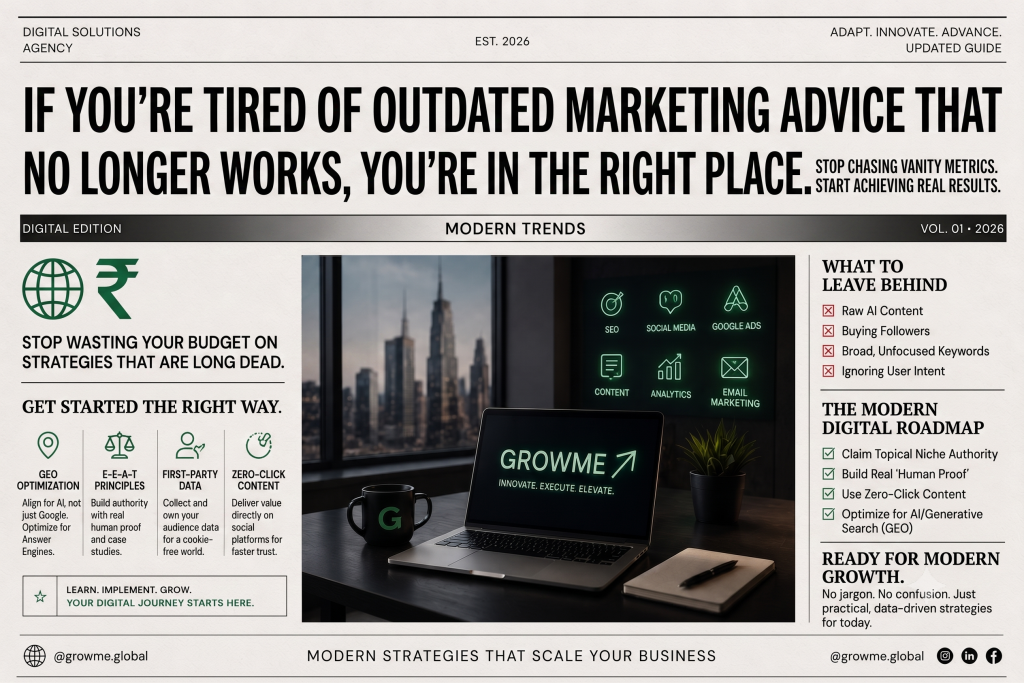
If you’re tired of outdated marketing advice that no longer works, you’re in the right place……

Digital Marketing Trends: What Is Working Right Now (And What’s Dead) Quick Summary: Digital marketing in 2026 relies on Generative Engine Optimization (GEO), real human experience (E-E-A-T), and zero-click content. Organic search traffic now favors direct, authoritative answers. To succeed today, brands must move past generic AI text and focus on structured, value-first content designed for both human readers and AI answer engines. If you’re tired of outdated marketing advice that no longer works, you’re in the right place. Between changing search engine algorithms, the rise of AI search overviews, and shifting audience habits, the old digital marketing playbooks from just a couple of years ago are officially broken. Below is your honest, step-by-step breakdown of how digital marketing actually works today—and how to future-proof your growth strategy.   1. What Are the Latest Trends in Digital Marketing Today? The single biggest shift in digital marketing is the transition from traditional search engines to hybrid AI search. Instead of users clicking through ten blue links on a search page, AI tools like Google AI Overviews, ChatGPT, and Perplexity now deliver direct summaries. To stay visible, modern digital marketing relies on three primary pillars: Generative Engine Optimization (GEO): Structuring your web content so AI models cite your business as the primary source. First-Hand E-E-A-T (Experience, Expertise, Authoritativeness, Trustworthiness): Search engines now actively demote generic, unedited AI content in favor of unique, human-backed insights. Zero-Click Marketing: Delivering value directly inside social feeds and search snippets to build instant brand trust without relying solely on web traffic. 2. SEO vs. GEO: How AI Changed Search Optimization For over two decades, traditional Search Engine Optimization (SEO) was about getting a page to rank #1 on Google for a specific keyword. Today, search involves two connected strategies: Feature Traditional SEO Generative Engine Optimization (GEO) Primary Goal Secure clicks from search engine result pages Secure citations inside AI-generated summaries Content Style Targeted keyword placement and backlink building Direct Q&A blocks, structured tables, and original data User Behavior Searcher clicks a link and visits your blog Searcher reads the AI summary featuring your brand credit Key Metric Click-Through Rate (CTR) Reference and Citation Rate To optimize for GEO, structure your articles with clear definitions near the top of every section, followed by bulleted steps and verifiable statistics. 3. The 4 Outdated Marketing Tactics to Stop Using Immediately If your organic traffic or conversion rates have dropped, you are likely still using strategies that search algorithms and modern audiences now filter out: ❌ Publishing Raw, Unedited AI Blogs: Publishing generic AI-generated text without human fact-checking or original insights leads to rapid ranking demotions. ❌ Chasing Vanity Metrics: Focusing purely on page views, video impressions, or follower counts instead of actual leads, sales conversions, and customer acquisition costs. ❌ Ignoring Mobile & Page Speed: Over 60% of web traffic happens on mobile devices. A slow, cluttered landing page kills conversion rates before a user even reads your headline. ❌ Broad, Unfocused Targeting: Trying to sell to “everyone” dilutes your message. Modern digital ad platforms work best when targeted at hyper-specific buyer personas. 4. Step-by-Step Playbook for Modern Digital Growth Follow this clear, 5-step roadmap to update your digital marketing execution: Step 1: Claim Your Niche Topical Authority Instead of writing random, disconnected blog posts, build Topic Clusters. Create one comprehensive ultimate guide (like this one) and link it to 5-10 smaller, deeply focused sub-topic articles. This signals to search engines that you hold genuine expertise across the topic. Step 2: Add Real “Human Proof” (E-E-A-T) Every article you publish should feature elements an AI cannot fake: Real screenshots and custom diagrams. Original quotes, case studies, or personal testing notes. Transparent author bios with links to verified professional profiles. Step 3: Implement Zero-Click Content on Social Channels Repurpose your long-form articles into native, bite-sized social content for platforms like LinkedIn, Instagram, and X. Give away the main takeaway upfront in the post body rather than forcing users to click an external link to get value. Step 4: Capture First-Party Data With third-party tracking cookies phasing out, build direct relationships with your audience. Offer interactive tools—such as quizzes, ROI calculators, or downloadable templates—in exchange for an email address. Step 5: Leverage Automated Email Sequences Email marketing continues to generate an average return of $36–$42 for every $1 invested. Set up automated welcome series and educational newsletters to convert casual leads into paying customers over time. 5. Essential Tools for Modern Digital Marketers Tool Category Top Tool Recommendations Primary Purpose AI & GEO Tracking Perplexity, Peec AI, SEMrush Track where and how your brand is cited across AI engines. Search & Web Analytics Google Analytics 4 (GA4), Google Search Console Monitor traffic sources, user behavior, and keyword indexing. Design & Media Canva, Figma Produce high-converting social visuals, infographics, and blog assets. Email Automation ConvertKit, Mailchimp, ActiveCampaign Build lead-nurturing funnels and automated email sequences.   Frequently Asked Questions (FAQs) What is the most important digital marketing skill today? Data literacy and content editing. While AI tools can draft raw text, human marketers are needed to direct strategy, verify factual accuracy, inject brand voice, and analyze conversion metrics.   Is blogging still effective for driving sales? Yes, but the goal of blogging has evolved. Blogs are no longer just for capturing high-volume clicks; they serve as structured knowledge bases that feed AI answer engines, establish E-E-A-T authority, and nurture middle-of-funnel leads.   How long does it take to see results from GEO and SEO? Organic search optimization typically requires 3 to 6 months to demonstrate compounding returns. However, clear Q&A formatting and schema markup can earn direct AI citations much faster. Final Thoughts Digital marketing is no longer a battle of who can publish the most content or spend the most on ads. In an era dominated by generative AI search, changing algorithms, and shifting audience behaviors, success comes down to three timeless pillars: clarity, authenticity, and real human connection. Artificial intelligence can draft articles, optimize bid strategies, and analyze performance data in

Beginner Guides, DIgital Marketing

Before You Spend ₹1 on Marketing, Read This Beginner’s Guide

Before You Spend ₹1 on Marketing, Read This Beginner’s Guide Every day, thousands of businesses spend money on ads, social media, and marketing tools—only to see little or no results. The problem isn’t the budget; it’s the lack of strategy. Before investing your first ₹1, it’s essential to understand how digital marketing works, which channels suit your business, and how to avoid costly beginner mistakes. This guide will give you the knowledge and confidence to make smarter marketing decisions, maximize your return on investment, and build a strong foundation for long-term online growth. 📅 Published: July 29, 2026 ⏱️ Read Time: 8–10 Minutes 👤 Author: Rajat Dubey 📂 Category: Digital Marketing 🏷️ Tags: SEO • Google Ads • Social Media • Beginner Guide What if I told you that most businesses don’t fail because they lack money—but because they spend it before learning how marketing actually works? Every day, businesses invest in ads, websites, and social media hoping for instant success. Yet many end up wasting time and money because they skip the fundamentals. This guide will help you avoid those mistakes and build a smarter marketing strategy from day one. 📚 Table of Contents What Is Digital Marketing? Why Every Business Needs Digital Marketing Traditional Marketing vs. Digital Marketing The Core Pillars of Digital Marketing Search Engine Optimization (SEO) Social Media Marketing (SMM) Search Engine Marketing (SEM) Content Marketing Email Marketing Pay-Per-Click (PPC) How Digital Marketing Works: From Visitor to Customer Common Beginner Mistakes to Avoid Essential Digital Marketing Tools for Beginners Step-by-Step Roadmap to Learn Digital Marketing Frequently Asked Questions (FAQs) Final Thoughts Ready to Grow Your Business? What is Digital Marketing? Digital marketing is the strategy of promoting products, services, or brands through electronic media and internet-connected devices. Unlike traditional marketing—which relies on static, one-way channels like billboards, television commercials, and printed flyers—digital marketing creates a dynamic, interactive ecosystem where businesses connect with specific audiences in real time. At its core, digital marketing operates across six main pillars, each serving a unique role in attracting and converting customers: Search Engine Optimization (SEO): The practice of optimizing website content and structure so that search engines like Google rank it higher in organic (unpaid) search results. Content Marketing: Creating and sharing valuable articles, videos, podcasts, and graphics designed to educate, entertain, and build trust with prospective buyers. Social Media Marketing (SMM): Utilizing platforms like Instagram, LinkedIn, YouTube, and X to build brand awareness, foster online communities, and engage directly with users. Pay-Per-Click (PPC) Advertising: Running paid ad campaigns on search engines or social media platforms where advertisers only pay when a user clicks on their ad. Email Marketing: Sending personalized, automated communications directly to a subscriber’s inbox to nurture leads, share updates, and drive repeat purchases. Affiliate and Influencer Marketing: Partnering with individuals or third-party creators to promote products to their established audiences in exchange for a commission or fee. What makes digital marketing exceptionally powerful compared to traditional methods is measurability, precision, and agility. In traditional advertising, calculating exact return on investment (ROI) is notoriously difficult. With digital marketing, web analytics tools allow businesses to track every step of the customer journey—from the exact moment a user clicks an ad to when they complete a purchase. Marketers can measure metrics like click-through rates (CTR), customer acquisition costs (CAC), and conversion rates with pin-point accuracy. Furthermore, digital channels offer hyper-targeted reach. Instead of broadcasting a message to a broad, untargeted audience, digital marketers can direct campaigns toward highly specific demographics based on age, geographical location, personal interests, online browsing behavior, or professional job titles. Finally, digital campaigns provide unmatched flexibility. If a paid ad or social media campaign isn’t performing well, marketers can adjust budgets, tweak creative assets, or change target parameters instantly—preventing wasted spend and continually optimizing performance. In today’s digital-first economy, consumer buying decisions start online. Whether a business is a local service provider or a global e-commerce store, digital marketing provides the tools necessary to build brand authority, generate qualified leads, and drive sustainable growth. Why Every Business Needs Digital Marketing? Why Every Business Needs Digital Marketing In today’s economy, digital marketing is no longer just an optional growth channel—it is a core business requirement. Over 70% of consumer purchase journeys begin online, meaning that if your business isn’t easily discoverable on digital platforms, it practically doesn’t exist to potential buyers. Whether you run a local service, a B2B platform, or a retail brand, digital marketing is critical for five compelling reasons. 1. Where the Audience Lives Consumers spend several hours every day on search engines, social networks, news sites, and video streaming platforms. Consumer Habit Shift: Buyers no longer wait for television ads or physical billboards; they actively research solutions on Google, seek product validation on social media, or read reviews on industry sites. Always-On Visibility: A well-optimized digital footprint ensures your business is discoverable 24 hours a day, 7 days a week, regardless of operating hours. 2. Unmatched Audience Precision Traditional channels reach a broad audience with minimal targeting control. Digital marketing allows you to direct campaigns with extreme accuracy. Traditional Marketing: Mass audience exposure via broad channels (TV, Billboards) with unfiltered reach. Digital Marketing: Hyper-targeted campaigns directed at specific buyer personas using search intent and demographic data. You can target prospective customers based on: Search Intent: Reach people actively typing queries related to your products (e.g., Google Search Ads). Demographics & Behaviors: Tailor ads by exact location, age group, job title, purchase history, or personal hobbies. 3. High ROI & Full Measurability One of the biggest advantages of digital marketing is verifiable attribution. Instead of guessing whether an offline advertisement drove sales, digital tools track performance down to the exact dollar. Channel Performance Benchmarks Email Marketing: Generates an average return of $36 to $42 per $1 spent. Excellent for lead nurturing and high customer retention. Pay-Per-Click (PPC): Generates an average return of $2 per $1 spent. Delivers fast, scalable traffic for immediate conversion goals. Organic Search (SEO): Delivers high long-term compounding traffic

Scroll to Top