
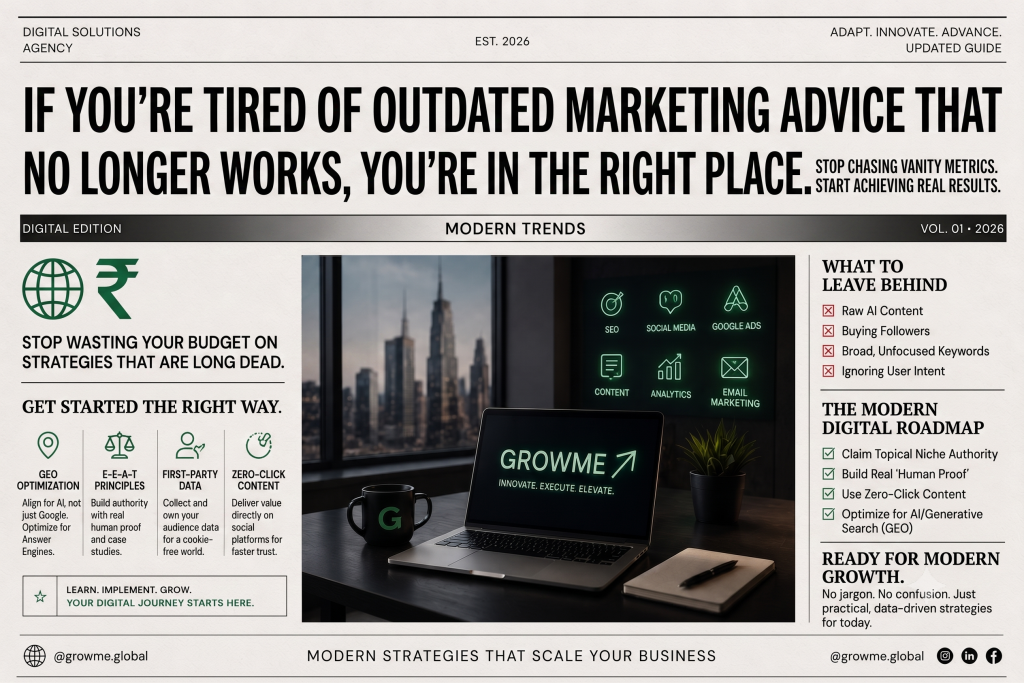
If you’re tired of outdated marketing advice that no longer works, you’re in the right place……
Digital Marketing Trends: What Is Working Right Now (And What’s Dead) Quick Summary: Digital marketing in 2026 relies on Generative Engine Optimization (GEO), real human experience (E-E-A-T), and zero-click content. Organic search traffic now favors direct, authoritative answers. To succeed today, brands must move past generic AI text and focus on structured, value-first content designed for both human readers and AI answer engines. If you’re tired of outdated marketing advice that no longer works, you’re in the right place. Between changing search engine algorithms, the rise of AI search overviews, and shifting audience habits, the old digital marketing playbooks from just a couple of years ago are officially broken. Below is your honest, step-by-step breakdown of how digital marketing actually works today—and how to future-proof your growth strategy. 1. What Are the Latest Trends in Digital Marketing Today? The single biggest shift in digital marketing is the transition from traditional search engines to hybrid AI search. Instead of users clicking through ten blue links on a search page, AI tools like Google AI Overviews, ChatGPT, and Perplexity now deliver direct summaries. To stay visible, modern digital marketing relies on three primary pillars: Generative Engine Optimization (GEO): Structuring your web content so AI models cite your business as the primary source. First-Hand E-E-A-T (Experience, Expertise, Authoritativeness, Trustworthiness): Search engines now actively demote generic, unedited AI content in favor of unique, human-backed insights. Zero-Click Marketing: Delivering value directly inside social feeds and search snippets to build instant brand trust without relying solely on web traffic. 2. SEO vs. GEO: How AI Changed Search Optimization For over two decades, traditional Search Engine Optimization (SEO) was about getting a page to rank #1 on Google for a specific keyword. Today, search involves two connected strategies: Feature Traditional SEO Generative Engine Optimization (GEO) Primary Goal Secure clicks from search engine result pages Secure citations inside AI-generated summaries Content Style Targeted keyword placement and backlink building Direct Q&A blocks, structured tables, and original data User Behavior Searcher clicks a link and visits your blog Searcher reads the AI summary featuring your brand credit Key Metric Click-Through Rate (CTR) Reference and Citation Rate To optimize for GEO, structure your articles with clear definitions near the top of every section, followed by bulleted steps and verifiable statistics. 3. The 4 Outdated Marketing Tactics to Stop Using Immediately If your organic traffic or conversion rates have dropped, you are likely still using strategies that search algorithms and modern audiences now filter out: ❌ Publishing Raw, Unedited AI Blogs: Publishing generic AI-generated text without human fact-checking or original insights leads to rapid ranking demotions. ❌ Chasing Vanity Metrics: Focusing purely on page views, video impressions, or follower counts instead of actual leads, sales conversions, and customer acquisition costs. ❌ Ignoring Mobile & Page Speed: Over 60% of web traffic happens on mobile devices. A slow, cluttered landing page kills conversion rates before a user even reads your headline. ❌ Broad, Unfocused Targeting: Trying to sell to “everyone” dilutes your message. Modern digital ad platforms work best when targeted at hyper-specific buyer personas. 4. Step-by-Step Playbook for Modern Digital Growth Follow this clear, 5-step roadmap to update your digital marketing execution: Step 1: Claim Your Niche Topical Authority Instead of writing random, disconnected blog posts, build Topic Clusters. Create one comprehensive ultimate guide (like this one) and link it to 5-10 smaller, deeply focused sub-topic articles. This signals to search engines that you hold genuine expertise across the topic. Step 2: Add Real “Human Proof” (E-E-A-T) Every article you publish should feature elements an AI cannot fake: Real screenshots and custom diagrams. Original quotes, case studies, or personal testing notes. Transparent author bios with links to verified professional profiles. Step 3: Implement Zero-Click Content on Social Channels Repurpose your long-form articles into native, bite-sized social content for platforms like LinkedIn, Instagram, and X. Give away the main takeaway upfront in the post body rather than forcing users to click an external link to get value. Step 4: Capture First-Party Data With third-party tracking cookies phasing out, build direct relationships with your audience. Offer interactive tools—such as quizzes, ROI calculators, or downloadable templates—in exchange for an email address. Step 5: Leverage Automated Email Sequences Email marketing continues to generate an average return of $36–$42 for every $1 invested. Set up automated welcome series and educational newsletters to convert casual leads into paying customers over time. 5. Essential Tools for Modern Digital Marketers Tool Category Top Tool Recommendations Primary Purpose AI & GEO Tracking Perplexity, Peec AI, SEMrush Track where and how your brand is cited across AI engines. Search & Web Analytics Google Analytics 4 (GA4), Google Search Console Monitor traffic sources, user behavior, and keyword indexing. Design & Media Canva, Figma Produce high-converting social visuals, infographics, and blog assets. Email Automation ConvertKit, Mailchimp, ActiveCampaign Build lead-nurturing funnels and automated email sequences. Frequently Asked Questions (FAQs) What is the most important digital marketing skill today? Data literacy and content editing. While AI tools can draft raw text, human marketers are needed to direct strategy, verify factual accuracy, inject brand voice, and analyze conversion metrics. Is blogging still effective for driving sales? Yes, but the goal of blogging has evolved. Blogs are no longer just for capturing high-volume clicks; they serve as structured knowledge bases that feed AI answer engines, establish E-E-A-T authority, and nurture middle-of-funnel leads. How long does it take to see results from GEO and SEO? Organic search optimization typically requires 3 to 6 months to demonstrate compounding returns. However, clear Q&A formatting and schema markup can earn direct AI citations much faster. Final Thoughts Digital marketing is no longer a battle of who can publish the most content or spend the most on ads. In an era dominated by generative AI search, changing algorithms, and shifting audience behaviors, success comes down to three timeless pillars: clarity, authenticity, and real human connection. Artificial intelligence can draft articles, optimize bid strategies, and analyze performance data in